

De Havilland DH.82a Tiger Moth by Airfix
1/72 Scale
Kit No. A01025
Retail: $17.00
Decals: One version – No. 10 Elementary Reserve and Flying Training School, RAF Yatesbury, 1940
Comments: Engraved panel lines, detailed cockpit with raised sidewall relief, separately mounted cockpit doors, one-piece engine cowling, stressed fabric effect on wings, rigging diagram included
 History
The de Havilland Aircraft Company originally designed their superlative Tiger Moth for the civilian market, primarily for those pilots interested in touring or flying club activities. The breed, however, passed through a range of iterations before settling into the familiar shape we see today. For instance, de Havilland moved the upper wing forward, revised the exhaust system, and even added small doors to the fuselage to make it easier for trainee pilots to escape a stricken aircraft while wearing a parachute. Furthermore, the wings were swept back slightly to maintain the same center-of-lift as before the adjustment in the location of the upper wing.
 The Tiger Moth is arguably the world’s most famous training aircraft, and is certainly one of the most recognizable. It was originally developed from the earlier Gipsy Moth. The first DH82 Tiger Moth flew for the first time on October 26, 1931 from Stag Lane Aerodrome, not far from Hendon and the current RAF Museum London. A few months later the Tiger Moth entered service at the RAF Central Flying School at RAF Upavon, Wiltshire.
 With the pre-war expansion of the RAF there was a great need for training aircraft. This led to a gradual increase in numbers. During the Second World War it provided the majority of RAF pilots with their elementary flying training. Eventually, over 8,800 Tiger Moths were built. Several served with other air forces.
 By the time WWII erupted, some 1,400 Tiger Moths were already in service with military and civilian operators across the British Commonwealth. Most of the civilian-operated examples were soon impressed into military service, forming the backbone of the British Commonwealth Air Training Plan. At the onset of hostilities, many British-based Tiger Moths were prepared for use in maritime patrol and as last ditch light bombers, should the United Kingdom be invaded.
 Modification as an Attack Aircraft: In the dark days leading up to and during the Battle of Britain, the Tiger Moth, which had already been adopted as a military trainer by the RAF, was considered for use as an anti-invasion strike aircraft. This was a time when Britain stood alone against Nazi Germany and was desperate for weapons and tactics it could employ to defeat a German airborne and seaborne invasion of the United Kingdom, which was considered imminent after the Dunkirk evacuation of June 1940. Britain military planners seized upon almost any anti-invasion idea, so the Tiger Moth was prepared for combat duties.
 At least three combat configurations were seriously considered. In August 1940, 350 Tiger Moths were fitted with light bomb racks. These aircraft were to undertake the bombing of enemy troops attempting a landing on the British coast. Second, was the ‘paraslasher’; a scythe-like blade was fitted to a Tiger Moth’s front end and outside the propeller arc — it was intended to cut parachutist’s canopies as they descended to earth. Flight tests proved the idea, but it was not officially adopted. Third, the Tiger Moth was strongly considered as a delivery platform for a biological weapon. The Tiger Moth ‘human crop sprayer’ used a tank fitted in the front cockpit with powder dispensers located under the wings. The tank would be filled with ‘Paris Green’, an extremely poisonous insecticide. It was intended that low flying aircraft would dust the German troops as they waded ashore.
Fortunately none of these ideas had to be employed, and the Tiger Moths remained with their Elementary Flying Training Schools to fulfill their vital role of pilot training. The casualty rate of the “Attack Moths” might well have been high, as they had a top speed of only 104 mph, a speed more closely associated with combat aircraft of World War I. But the British situation was so dire in the Summer of 1940 that even the above rather extreme ideas were seriously contemplated.
 Between 1939 and 1945, de Havilland built 4,005 Tiger Moths in the United Kingdom and 1,747 in Canada. After the plane was declared surplus in 1947, it became perhaps the most widely operated biplane in Canada and Europe. Several examples have recently been imported into the United States and are finding great favor for their acrobatic capability and antiquated appearance. A few years after the war it was replaced by the brilliant de Havilland Canada Chipmunk. The DH82 was officially retired from service in 1959 but many still fly in civilian hands. One unusual aspect of the Tiger Moth is that its engine is actually mounted upside down. It features a de Havilland Gipsy Major inverted 4-cylinder engine, which can generate up to 130 hp.
 The Kit

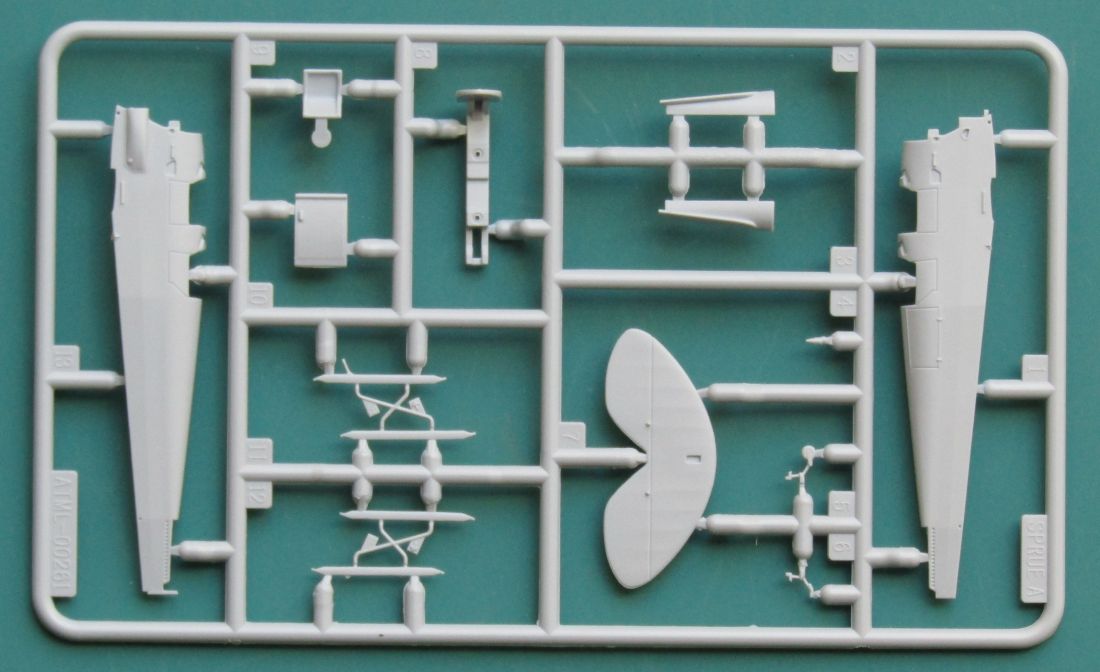
Airfix’ DH. 82 Tiger Moth is injection molded in grey plastic and consists of 42 parts, including two clear plastic parts for the windshields. This kit, released in 2013, is a vast improvement over the classic Airfix mold of the Tiger Moth first issued in 1959. It bears engraved panel lines for all control surfaces as well as stressed fabric effects throughout the airframe. The internal fuselage sidewalls feature exquisite ribbing detail and raised relief instrumentation, individual control yokes, and separate instrument panels for which decals are provided.
Parts are included to depict the side doors to the cockpit open, if modelers are willing to engage in minor surgery to remove the existing doors (which are closed) that are integrally molded into the left half of the fuselage. If this option is chosen, holes must be drilled into the left fuselage half where indicated by the instructions. There is a separate, well-detailed part for engine cowling along with a one-piece, two-bladed propeller.
The front and rear interplane struts for each wing are molded as a single part, simplifying the problem of having them lean at identical angle and line up appropriately with corresponding holes in the upper and lower wings. Likewise for the cabane struts attaching the upper wing to the fuselage. The fuel tank is separately mounted in the center section of the upper wing. The five-piece main landing gear appears to be an exercise in simplicity, augmented by a diminutive tail skid. The final page of the instructions is dedicated to a series of rigging diagrams.
 Markings

Decals are provided for a single version of the Tiger Moth, a trainer based at No. 10 Elementary Reserve and Flying Training School, Royal Air Force Yatesbury at Wiltshire, England, 1940. This aircraft, serial no. N-9181, is painted in a camouflage scheme of Dark Earth and Dark Green on its upper surfaces, with Matt Yellow covering all under surfaces as well as the lower fuselage sides. The decals, as is typical of all newly tooled Airfix kits of the past 15 years or so, are excellent. Their color is accurate, they are fully in register, and they have a faint semi-gloss sheen.
Conclusion
This is a highly detailed update of the classic Airfix Tiger Moth. You will not find a more meticulously designed weekend kit. Highly recommended.
References
- https://www.rafmuseum.org.uk
- https://www.militaryaviationmuseum.org
- https://planeandpilotmag.com