
 Boeing RB-47H Reconnaissance by Hobby Craft

1/144 scale
Kit No. HC1252
Retail: $35.00
Decals: One version – USAF 55th Strategic Reconnaissance Wing, 1967
Comments: Engraved panel lines, one-piece canopy, nicely detailed intake fans on engine nacelles
 History

During the early part of the Cold War, the U.S. Air Force needed an aircraft to gather information about Soviet air defense radar systems, including details like their location, range and coverage. The electronic reconnaissance RB-47H, developed from the B-47E, met this requirement, and Boeing completed the first RB-47H in 1955. Boeing produced 32 newly built RB-47Hs and converted three B-47Es into ERB-47Hs.
 The RB-47H first entered service in August 1955. Over the next decade, RB-47H crews of the 55th Strategic Reconnaissance Wing (SRW) flew thousands of dangerous “ferret” missions. Flying in radio silence at night along — and sometimes over — the border of the Soviet Union and other communist nations, RB-47Hs collected essential intelligence about the size and capability of Soviet air defense radar networks. The need for this information and the relatively small number of RB-47Hs forced crews to spend much of their time deployed to places around the world, away from their homes at Forbes AFB, Kan. The RB-47H continued in service until the more capable RC-135 replaced it in the mid-1960s.
 The museum’s RB-47H was delivered to the USAF in October 1955. The aircraft served with the 55th SRW from 1955 until its retirement in 1966. During this time, it deployed to several locations, including Incirlik Air Base, Turkey, and Yokota Air Base, Japan, and flew missions over the Soviet Union. The aircraft was acquired by the museum in 1998 from the City of Salina, Kan. After extensive restoration by museum personnel, the aircraft went on display in 2003, marked as it appeared in 1960.
 The B-47 Stratojet in the Cold War
The B-47 Stratojet became an essential component of the U.S. Air Force’s Strategic Air Command (SAC) during the 1950’s and early 1960’s, both as a nuclear bomber and a reconnaissance aircraft. Designed to meet a 1944 requirement, the first XB-47 prototype flew in December 1947, performing far beyond its competitors. It incorporated many advanced features for the time, including swept wings, jet engines in underwing nacelles, fuselage mounted main landing gear and automated systems that reduced the standard crew size to three.
 In May 1951 the B-47 began replacing the propeller-driven B-29’s and B-50’s (B-29’s modified for reconnaissance) in SAC’s medium bomber units. While it could carry about the same bomb tonnage as the aircraft it replaced, the B-47’s top speed was more than 200 mph faster. Since the B-47 did not have the range of SAC’s heavy bombers (the B-36 and later the B-52), Stratojet units regularly deployed to forward air bases around the world on temporary duty. Initially these deployments lasted three months, but beginning in 1957 under the Reflex Action program, they were shortened to three weeks.
 In addition to its role as a nuclear strike bomber, the Stratojet’s speed and payload made it a useful strategic reconnaissance aircraft. Between 1952 and 1956, photographic reconnaissance versions of B-47s conducted several overflights of the Soviet Union, providing detailed pictures of Soviet military and industrial facilities. Stratojets gathered intelligence about Soviet air defense systems and the Soviet intercontinental ballistic missile program. Weather reconnaissance versions of the B-47 not only collected weather data, but also took air samples of Soviet nuclear detonations. These essential RB-47 missions over and along the border of the Soviet Union were hazardous, and Soviet fighters damaged one reconnaissance Stratojet and shot down two, with the loss of seven USAF personnel killed and two temporarily imprisoned.

Diagram showing the three positions in the RB-47’s converted bomb bay for the three electronic warfare officers, who had the least chance of successful ejection in the event of trouble. Image credit: nationalmuseum.af.mil
To prepare its B-47 for the reconnaissance role, Boeing stripped out the bombing gear and replaced it with a host of electronic intelligence equipment: scanners, receivers and recording gear, some of which were housed in blisters on the fuselage and wings. Cameras could also be fitted, depending on the mission. The nose was lengthened and the bombardier equipment removed to accommodate a radar detector. A total of 35 airframes were converted to this B-47H configuration.
The Kola Incident
The most famous RB-47 reconnaissance mission, although overshadowed by the U-2 incident two months previously, targeted the Kola peninsula in the northwest part of the Soviet Union, just inside the Arctic Circle. Kola was the headquarters of the Soviet Navy’s formidable Northern Fleet, and the site of some of the toughest air defenses in the Soviet Union. Concentrated around the Murmansk region, hidden among the fjords, were submarine pens (housing ballistic missile subs), missile bunkers, naval airfields, radar early warning facilities, and deep water shipyards. Tu-16 and Tu-95 surveillance aircraft, which could double as nuclear bombers, were also based there. NATO had determined that the Kola peninsula was among the highest priority strategic targets in the event of war, and the Soviets knew it. Accordingly, Kola represented some of the most heavily defended airspace in the Soviet Union.

The crew of Raven 23, the ill-fated RB-47 mission shot down near the Kola peninsula in the Soviet Union on July 1, 1960. From left, Major Willard George Palm, aircraft commander; Major Eugene E. Posa, Captain Freeman Bruce Olmstead, co-pilot/gunner; Captain Oscar Lee Goforth; Captain John Richard McKone, navigator/photographer; and Captain Dean Bowen Phillips. Posa, Goforth and Phillips were the “Ravens,” the electronic warfare officers stationed in the electronics pod. Of the six, only McKone and Olmstead survived.
The U.S. believed it was vital to conduct surveillance of these sites, document radar signature capabilities, and collect intelligence on the Kola peninsula’s air defense capabilities. U-2 flights from an altitude of 70,000 feet were helpful but could not provide a complete picture. Lower level flights by ELINT (electronic intelligence aircraft) like the RB-47H were essential to identifying the existence and location of radars, missile guidance systems, communications and telemetry transmissions that would provide the West a comprehensive picture of the Soviets’ air defense posture in the Kola area.
On July 1, 1960, two months to the day after the more famous U-2 incident in which CIA pilot Francis Gary Powers was shot down by a surface-to-air missile, an order came through from the Strategic Air Command to an RB-47 detachment based at RAF Brize Norton in the UK. It called for electronic intelligence collection involving a flight that would track the coast of Norway, enter the Barents Sea, then fly a triangular pattern  that would take the aircraft within 50 nautical miles of the coast of the Kola peninsula in the Soviet Union. The aircraft would be in international waters at all times, although its purpose, probing Soviet air defenses, was in time clear to the Russians. RB-47H serial number 53-4281 drew the assignment, piloted by Major Williard G. Palm with Captain Freeman Olmstead as his co-pilot. Captain John R. McKone was the navigator, and for this mission they would carry three electronic warfare officers. Their call sign would be Raven 23. Their RB-47 skirted along the edge of Soviet territory near the Kola military installations, collecting the necessary electronic intelligence in what was called a “ferret mission” that would help map out the air defenses in the Kola peninsula. Such data helped develop electronic countermeasures that could confuse Soviet radar systems, and would later assist the development of stealth aircraft, defining much of the early Cold War doctrine.
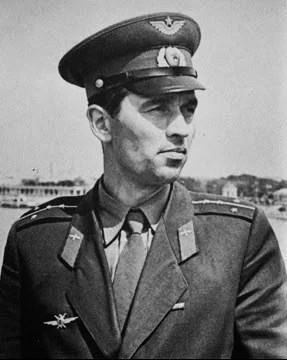
Captain Vasily Polyakov, the MiG-19 pilot who intercepted and shot down Raven 23.
Captain Vasily Polyakov was scrambled to intercept in his MiG-19. Going supersonic during the interception, he came upon the RB-47, and although he claimed he wagged his wings at the American aircraft, a signal for it to follow him, there is no evidence that the Americans saw this maneuver. Moments later, Polyakov was authorized by Soviet ground control to shoot the RB-47 down. He made two firing passes, raking it with 30 mm shells and crippling the aircraft, as a result of which at least three crew members, Major Williard Palm, Captain John McKone, and Captain Freeman “Bruce” Olmstead, ejected. Major Palm may not have survived the ejection, and his body was recovered by a Soviet ship on July 4th. The remaining three crew members, the electronic warfare officers (called “Ravens”), were never seen again and were presumed dead. There is no proof that any of them ever ejected from the aircraft. They were: Major Eugene Posa, Captain Oscar Goforth, and Captain Dean Phillips. The only survivors were Captain John McKone, the navigator, and Captain Freeman “Bruce” Olmstead.
Soviet records — those that have been released to the West — are vague, but at one point the RB-47 may have been as close as 30 miles from the Soviet coast, despite the stated flight plan. Statements issued by Premier Nikita Khruschev at the time insisted the RB-47 had violated Soviet territory, but were vague as to the precise location of the RB-47 at the time of the shoot-down.

The MiG-19, a lethal Russian fighter armed with three heavy 30mm Nudelman-Richter cannon.
Captains Olmstead and McKone were imprisoned and interrogated by the Soviets for six months, until Khrushchev ordered their release in January 1961, reportedly as a gesture of goodwill toward President-Elect John F. Kennedy. One factor in Krushchev’s decision may have been that McKone and Olmstead were steadfast in maintaining, unlike U-2 pilot Gary Powers, that they never violated Soviet airspace and remained over international waters during their entire flight, even though their purpose was to gather electronic intelligence.
Between 1947 and 1957, Boeing, Douglas and Lockheed built over 2,000 Stratojets. At its peak use in 1958, the USAF operated 28 B-47 bomb wings and four RB-47 reconnaissance wings, totaling 1,357 B-47s and 175 RB-47s. The USAF phased out its last B-47 bombers in 1965, and the USAF retired its last Stratojet, a WB-47E, in 1969.
 The Kit

Hobby Craft’s RB-47H features crisply engraved panel lines and is injection molded in grey plastic and consists of 89 parts on five sprues, including a single clear part for the canopy which thankfully bears inscribed detail for the canopy frame, something not always seen in 1/144 scale. Another unusual feature for this scale is that the kit includes a flight deck with seats and a control yoke for the pilot. Finally, there is a rudimentary paint guide for the cockpit.
There are boxed-in main wheel wells for the fuselage-mounted landing gear, and the instructions call for holes to be drilled in the bottom and rear sides of the fuselage for the series of electronic sensors mounted to this reconnaissance version of the B-47. Likewise holes must be drilled in the top half of the wing for a dorsally mounted sensor, and on the bottom half of the two-piece wing to accommodate the auxiliary fuel tanks.
Other than the basic cockpit provided there is no real interior, and once the fuselage halves are together the focus shifts to the engine nacelles, the intakes of which are nicely detailed for this scale, then the landing gear and drop tanks. The eight externally mounted fuselage sensors are cemented on last.
One deficiency in the kit instructions is that there is no complete top view of the aircraft, only an illustration depicting the aircraft from an area a little forward of the leading edge of the wings, going aft to the tail. The nose is excluded. The problem with this is that a black anti-glare panel must be painted around the canopy, and modelers will have to rely on photographs as to what this panel should look like in terms of the forward dimensions on the nose ahead of the pilot’s windscreen. It should not be too difficult, but it is something to be aware of.
 Markings

Decals are provided for two different RB-47H aircraft of the 55th Strategic Reconnaissance Wing, circa 1967. All markings are made by Hobby Craft, they have good color and are fully in register. The two versions are virtually identical except for the serial numbers on the tail, and the corresponding aircraft numbers on the nose. The first is aircraft number 4296, tail serial number 0-34296. The second is aircraft number 4280, tail serial number 0-34280. Markings are even provided for what may be camera apertures for the biggest of the sensor blisters mounted on the plane’s belly.
One marking included on the decal sheet but for some reason not seen on the illustration of the finished kit in the instructions is the diagonal light blue flash bearing white stars often seen on B-47’s in service. This marking extended from the cockpit and downward at and diagonal angle toward the first of the plane’s forward fuselage-mounted landing gear.

Conclusion
This is a beautifully rendered kit of a widely used reconnaissance platform that saw extensive service during the early years of the Cold War. While less famous today than the U-2 or the SR-71, the RB-47H fulfulled a critical surveillance and reconnaissance function during a critical period. Highly recommended for its ease on construction and historical interest.
References
- www.nationalmuseum.af.mil
- www.thisdayinaviation.com
- “The Kola Shoot Down Incident” – YouTube video – https://www.youtube.com/watch?v=TIXOncjMxEI