
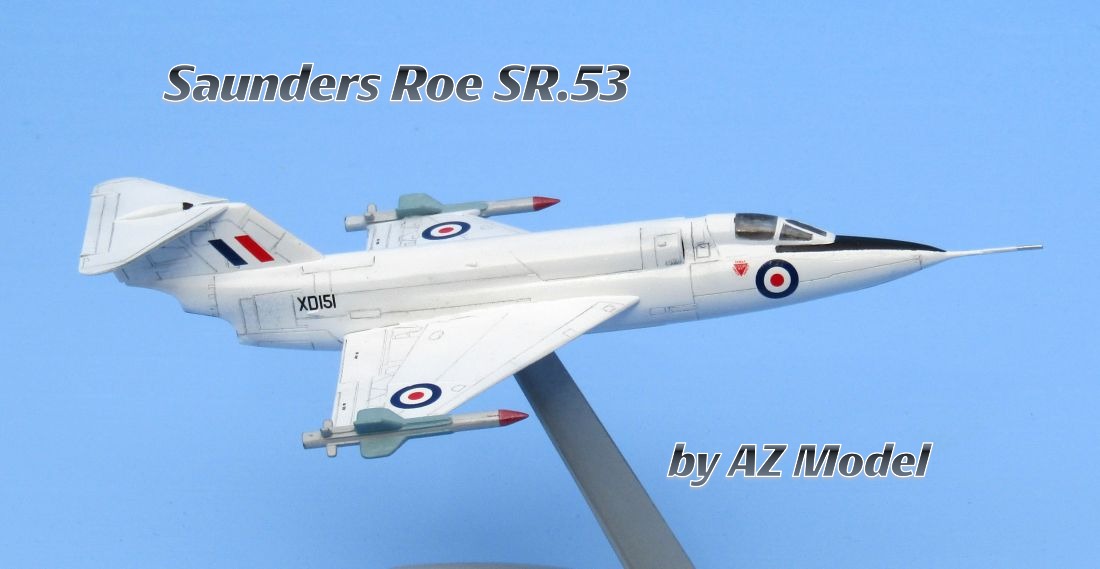
Saunders Roe SR.53 by AZ Model
1/72 scale
Kit No. 7578
Retail: $30.00
Decals: Two versions, both for prototype aircraft – XD145 and XD151
Comments: Engraved panel lines, one-piece canopy, optional position landing gear, option for Firestreak air-to-air missiles
 History

The Saunders Roe SR.53 was a prototype interceptor of the late 1950’s inspired by and intended as a modern update of the Messerschmitt Me 163 rocket fighter. It was the first British military aircraft to have a hybrid powerplant in the form of both a turbojet as well as a rocket engine. As the Cold War intensified in the early 1950’s in the wake of the Berlin Airlift and the outbreak of the Korean War, both the British and American governments were concerned — very nearly obsessed — about the prospect of jet powered bombers from Soviet Russia flying over the Arctic Circle to attack and rain nuclear destruction upon their cities.
 This led to an urgent, corresponding emphasis on the development of state-of-the-art interceptors that could quickly climb to altitude and destroy the Russians before they could reach their targets. This was attended by a concern that the radars of the day were not so good that they could guarantee ample warning time of an impending attack. Also at the time design work began on the SR.53, surface-to-air missiles were still in development, their deployment years in the future.
Accordingly, the British government issued specifications for a new interceptor to tackle the Soviet threat in the nuclear age, and Saunders Roe was among the firms that submitted proposals in response. Initially, the SR.53 design copied very closely the engineering and flight profile of the Messerschmitt Me 163. It was to have a single rocket engine, disposable undercarriage to be jettisoned immediately after take-off, and since the rocket’s limited fuel supply was to be very quickly exhausted, it was intended to glide back to earth unpowered.
 However, Saunders Roe realized that the unpowered, hopefully successful return to base would be both dangerous and expensive, at best requiring periodic repairs to the airframe and at worst costing the lives of pilots as well as the potential write-off of the entire aircraft. They therefore approached the Air Ministry with the idea of a secondary jet engine to power the flight home (and later, to possibly get the SR.53 aloft and into an attack profile before igniting the jet engine), together with the addition of conventional landing gear. The Air Ministry were enthusiastic and in May 1951 ordered the tandem engine arrangement to be examined; this was followed in February 1952 by a formal requirement for such an aircraft.
 The protracted five-year development of what became the SR.53 that followed entailed changes of armament — initially involving a battery of unguided 2-inch rockets and morphing into the Blue Jay infrared-guided air-to-air missile, ultimately settling upon the de Havilland Firestreak air-to-air missile — and delays in the development of de Havilland’s Spectre rocket engine, which at one point exploded during a ground test. Finally, there was at least one major redesign of the entire airframe.
 The SR.53 that emerged from this lengthy gestation was a sleek aircraft with a sharply-pointed nose, delta-like wing, and a T-tail. It was powered by a combination of a single Armstrong Siddeley Viper turbojet engine and a de Havilland Spectre rocket engine, the exhausts of which were mounted one atop the other on the rear fuselage beneath the tail. Saunders-Roe had originally proposed to develop their own rocket motor to power the SR.53, having been at first blush unimpressed with the performance of the Spectre; however, it was recognised that this would take substantial development work. By October 1952, the basic outline of the aircraft had been finalized, replacing the combined flap and ailerons of earlier proposals with slotted flaps. The Viper engine was relocated on top of the Spectre and was to be fitted with a straight jet pipe rather than a bifurcated one, and the tailplane was also moved to a higher position at the top of the fin to avoid heat damage from the jet and rocket exhausts.
 The SR.53 prototype, XD145, finally took its maiden flight on May 16, 1957 with Squadron Leader John Booth, DFC at the controls. Test results indicated “…an extremely docile and exceedingly pleasant aircraft to fly, with very well harmonized controls.” Both prototypes, XD145 and XD151, flew a total of 56 test flights, achieving speeds of Mach 1.33. They handled beautifully and gave every indication of fulfilling the Air Ministry’s specifications, with a fantastic climb rate of 52,800 feet per minute with the rocket engine engaged, a maximum speed of 1,612 mph (2,594 km/hour) at 36,000 feet, and a service ceiling of 60,000 feet. However, six years had elapsed since the specifications were issued, with corresponding changes in aviation technology. While the SR.53’s performance was undeniably impressive, the development of intercontinential ballistic missiles (ICBM’s) compelled a change in British defense policy.
 The SR.53 had the misfortune to take flight one month after the release of the April 1957 Defence White Paper, outlining the British government’s policy to largely abandon piloted aircraft in favour of concentrating on missile development. While subsequent events would later partially discredit this approach, they did not come in time to save the revolutionary SR.53. Throughout the 1950’s, steady improvements in jet engine as well as radar and surface-to-air missile technology meant that by 1957 any incoming bomber threat could be detected and successfully intercepted with either ground-based missiles or conventional jet fighters (such as the English Electric Lightning then in development) much earlier. This in turn led to the British government’s conclusion that the need for an aircraft like the SR.53 had largely disappeared.
 The second prototype, XD151, joined the program in December 1957 but crashed three months later for unexplained reasons, killing the pilot and effectively ending the program. The first SR.53 prototype, XD145, is preserved at the Royal Air Force Museum Cosford near Wolverhampton.
For additional information on the history of the SR.53, see the preview of this kit here.
 Construction

This was my first AZ Model kit, and while it has a much appreciated modern feature in the form of engraved panel lines, I would put it on par with Airfix kits of the 1970’s in terms of its fit. The cockpit is nicely detailed with its separate control yoke and raised relief on the main and side instrument panels and overall assembled smoothly, but when it came time to close up the fuselage, the lack of locator pins made the proper alignment rather tricky — putty and sanding were definitely required.
 The major components of the kit came together without incident, and with the fuselage sealed up, the airframe builds up quickly. A minor complaint I have deals with the missiles. They were in two halves which is unusual for 1/72 scale, and for all the rich engraved detail on the aircraft, the missiles had none. It was almost as if they were copped from a different, older kit. Assembly of the main airframe went smoothly after the challenge of the fuselage. If you want to add the missiles it is necessary to sand off the ends of the wingtips and cement separate parts for missile rails on in their place, but this presented no problems.
 Another minor issue, which does not affect the final appearance of the kit, is the two parts for the interior of the intakes behind the cockpit. These fairly small and fiddly parts, which are cemented to the fuselage interior, presumably to provide some depth should anyone care to peek inside the intakes once the kit is complete, do not seem to serve any real purpose, for one reason: The apertures for the intakes are so small that it’s virtually impossible to see much of anything inside. Since no effort is made to provide parts for intake trunking, these two parts really seem to be unnecessary.
The fit issue came up again when it came time to cement the canopy on. The canopy is crooked, it’s that simple. Modelers should dry fit this part early on and do what they can to mitigate it if the canopy alignment is less than perfect. I tried sanding down one side of the rear of the canopy, and the fuselage contact point, which helped somewhat, but it reminded me of older, pre-2000 molds which sometimes gave injection molded canopies a bad name.
 Painting

The SR.53 is airbrushed in Cool White (GX 1), a gloss acrylic from the Gunze Sangyo Mr. Color line. In my experience, this paint airbrushes on far more smoothly than either Tamiya’s Gloss White acrylic or Humbrol’s Gloss White enamel, both of which have a tendency to spatter. The anti-glare panel is Tamiya Flat Black, and the missiles were painted in overall Silver Grey, a paint I mixed using Vallejo acrylics, Silver Grey and Aluminum, in roughly equal portions; the fins were painted in Blue (FS 35414), a Model Master enamel (No. 2033) that to my eye is more a pale blue-grey; and the missile warheads were painted in a Humbrol enamel, Polished Aluminum Metalcote (No. 27002), covered with light airbrushed applications of Red (No. 327), (FS 11136), an acrylic from the Gunze Sangyo Mr. Hobby line.
 Markings

The kit markings were bright with realistic color, perfectly in register and readily adhered to the surface of the model, but did not grip it so enthusiastically that they could not be moved once they touched the kit. They responded well to decal solvent and provided no problems. Although stencils were provided, many of them were illegible and blurry so I did not use most of them. The red “Danger” triangles near the canopy that are seen are the kit are aftermarket substitutes I used after examining the ones that came with the kit. They were formless red blurs that did not clearly depict the triangle at all.
Conclusion
Despite its shortcomings AZ Models have produced a beautiful kit of a Cold War icon that really has a certain mystique about it, in light of its demise at the hands of Lockheed’s F-104 Starfighter, to which it bears a superficial resemblance. This little gem is a welcome update to the aging MPC/Airfix kit, and represents a fascinating period of Cold War history. Highly recommended.

References
- ukdefenceforum.net
- Edito-Service S.A. Saunders Roe SR..53 Aircraft Card
- wikipedia.org