

Let L-200 A/D Morava by AZ Model
1/72 scale
Kit No. AZ7352
Retail: $46.00
Decals: Three versions – Czech Republic, Bulgaria, Indonesia, and U.S. Air Force
Comments: Engraved panel lines and recessed rivet detail; resin cabin, seats and wheels; photo-etch details and paint masks included
 History

The Let L-200 Morava was a light twin-engine transport designed and produced by Let Kunovice in the Czech Republic. It was preceded in production at the Let factory by the license-built Aero Ae 45. In 1955 the newly created design team led by Ladislav Smrcek of the Czechoslovak State Aircraft Factory decided to proceed with a proprietary design for a more modern twin with seating capacity of five and powered by a pair of then new 210 hp Avia M 337 engines, but as they were not yet available, the prototype made do with the less powerful Walter Minor 6-III engines of 160 hp each. While maintaining similar characteristics of western twin engine aircraft of the time, updated features of the Morava included twin tails, standard thermal wing de-icing equipment and inverted inline engines.
 Three prototypes were built. The first, designated XL-200 (OK-LNA) made its maiden flight on April 9, 1957. It was followed in flight testing by the second prototype (OK-LNB) while the third was used for static testing. The aircraft sported clean, elegant lines. Also in 1957 the factory built a run of 10 pre-production L-200s, one of these aircraft undergoing government flight testing in 1958. The program was successful, and the airplane was ordered into full-scale production. One L-200 was converted into a prototype of the M-337-powered production model L-200A. This aircraft incorporated minor changes, consisting mostly of new two-blade V-410 propellers, a cockpit lowered by 43mm, a modified tailfin design as well as longer engine nacelles. It was completed in 1959 and shown at the Paris Air Show in July of that year. The aircraft underwent government trials in the fall of 1959, having been fitted with M-337 engines. The trials once again proved successful and were completed the following July. The first production L-200A took to the skies in February 1960.
 L-200B and C models were not produced. The second production variant was the L-200D, modified according to Soviet Aeroflot demands. It was fitted with new three-blade propellers V-506 of a smaller diameter and some minor improvements, such as dust filters. It also received more comprehensive navigation equipment. The prototype (OK-NIA) was converted from the L-200A prototype in 1960 and tested in 1961-1963.
 In all, 367 L-200s were built by 1964, including 3 prototypes and 197 L-200D (eight L-200A and the L-200A prototype were converted to L-200D as well). Five aircraft were manufactured from parts by Libis in Yugoslavia. The pre-series aircraft L-200 were distributed for testing: 5 to the Czechoslovak airline Agrolet (OK-MEA – MEE), 2 to the Czechoslovak Air Force and 2 to Aeroflot in the USSR.
 Aeroflot, who used them as air taxis, was the largest single user of Moravas: 68 L-200A’s and 113 L-200D’s, with final deliveries taking place in 1966. In the 1970s however, the Soviet Union sold or withdrew its aircraft from use, in favour of indigenous designs.
About 100 Moravas were used for civilian purposes in Czechoslovakia by aeroclubs Svazarm (about 50), the airlines Agrolet (from 1969 Slov-Air) and Czechoslovak Airlines (45) and by businesses, such as Škoda. 20 were used by the Czechoslovak Air Force (16 of which L-200A), among others, for training. About 50 were sold to Poland, where they were used mostly as air ambulances and in aeroclubs. Some other countries had smaller fleets of Moravas.
 During the Cold War, not many light aircraft were exported from behind the Iron Curtain, but 144 L-200A’s were exported to 15 countries. They were used in Australia, Argentina, Cuba, Hungary, West Germany, Great Britain, Egypt, India, Italy, Poland, South Africa, USSR and Yugoslavia. L-200D were exported to Bulgaria, Cuba, Egypt, France, Hungary, GDR, Great Britain, India, Indonesia, Italy, Poland, Switzerland, Sweden, USSR and Yugoslavia. A small number of Moravas were still in used as of 2008, mainly in the Czech Republic, Slovakia Poland and Ukraine.
 The Kit

AZ Model’s Let L-200 A/D in injection moled in grey plastic and consists of 38 parts, including 6 clear parts for the windscreen and cabin windows. Both a film insert and photo etch detail part are provided for the main instrument panel in the cabin, which features a resin floor and seats, and photo etch (PE) details for the rudder pedals and bomber-style control wheels. A separate PE part is also provided for the windshield wiper.
The kit is fairly detailed, with each engine nacelle consisting of six parts, including separately mounted intake scoops and engine exhaust pipes. There are separate parts for the wingtip tanks, and a choice of two- or three-bladed propellers for each airscrew. There are also a number of PE parts providing exterior detail for blade antennae, aileron actuators, a pitot tube, landing gear doors, and protective tail skid, notwithstanding the plane’s tricycle landing gear.
 Markings

The kit markings have excellent color, are fully in register, and have a beautiful semi-gloss finish. While national insignia are provided for three of the four versions (U.S., Czech, and Bulgarian), apparently the only markings for the Indonesian Air Force version are the call letters on the twin vertical tails (PK-ARB).
 The Czech and Indonesian versions appear in a scheme of overall Aluminum with white wing tip tanks and blue spinners, with the spinners on the Czech version a slightly darker shade of blue. The Czech version also differs from its Indonesian counterpart in having red flashes at the top and bottom of its vertical tails, with a blue border on the upper flash.
The Bulgarian version is the most colorful of all, with Medium Blue upper surfaces for the fuselage and engine nacelles only, White vertical tails with Medium Blue along their leading edges, and Aluminum under surfaces. The spinners are Red and White. This version is the only version not to include a Black anti-glare panel on the nose forward of the cockpit.
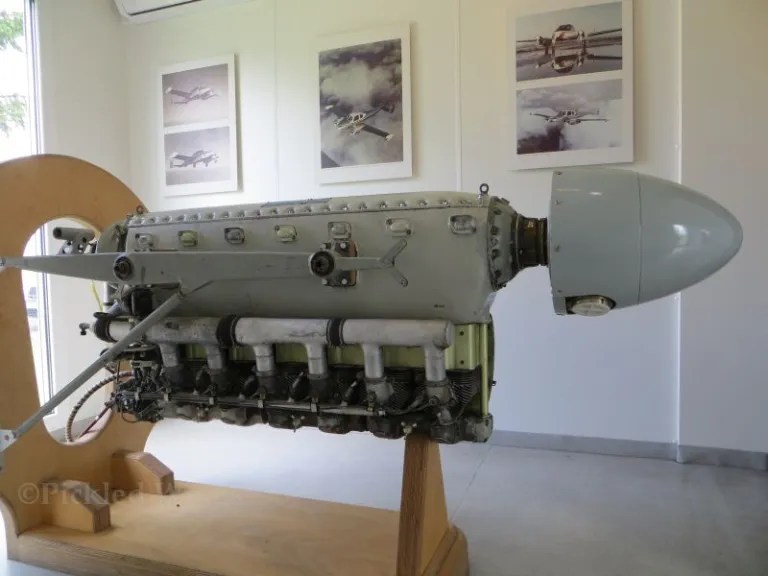
A pair of Czech-developed Walter M337 engines powered the Morava. The M337 was a fuel injected, inverted six cylinder, supercharged engine generating 210 horsepower and driving the Morava to a maximum speed of about 300 kph (186 mph).
The U.S. Air Force version features a paint scheme of White over Aluminum under surfaces, with the spinners and engine nacelles painted Red.
Conclusion
This is an unusual kit of a successful light aircraft from a former Eastern Bloc country, one that had a reasonably strong export record even during the Cold War. Highly recommended.
References
- https://all-aero.com
- pickledwings.com
